
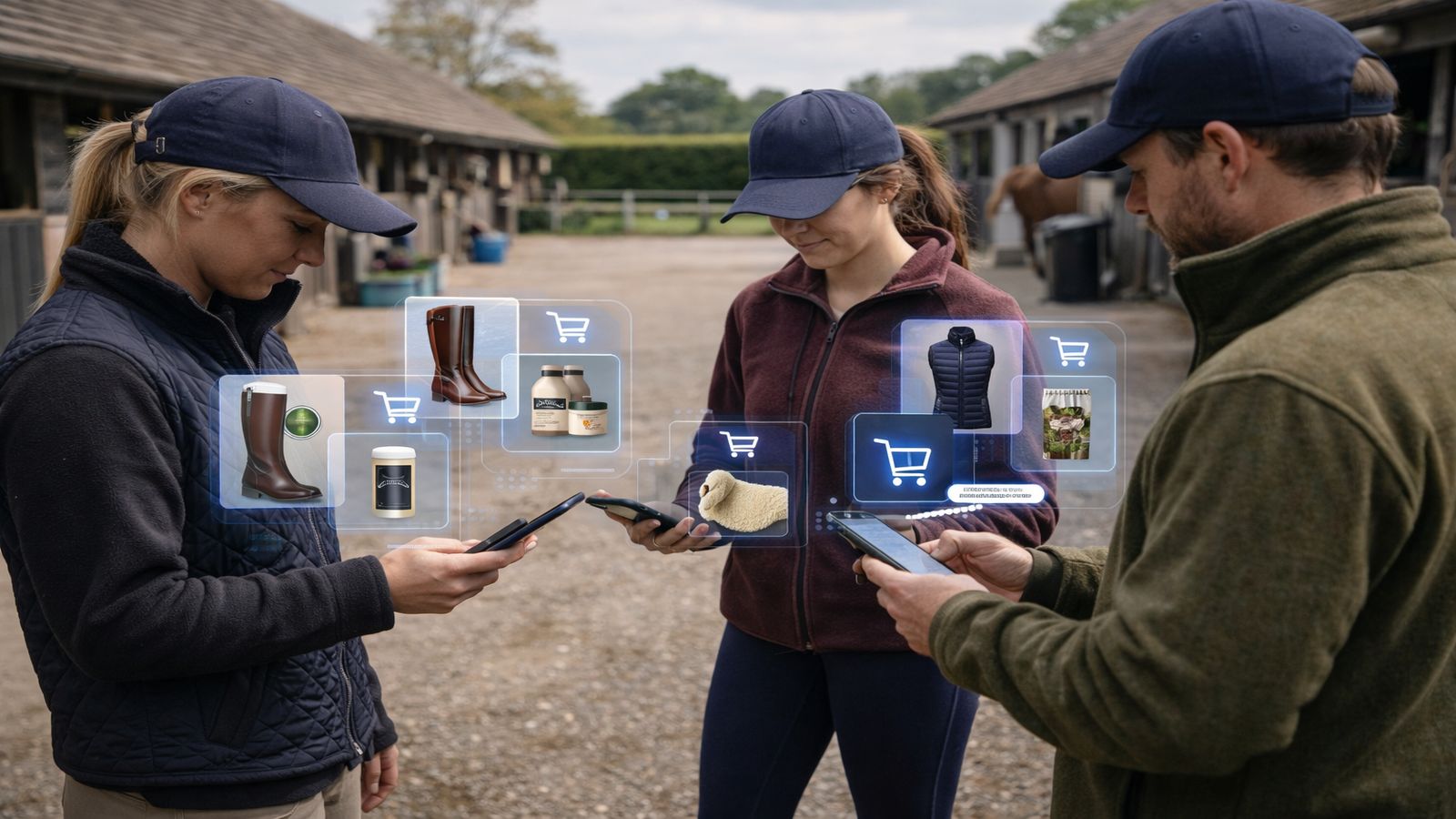
A Smarter Approach to Equestrian & Country Lifestyle Advertising
Advertising to rural and equestrian consumers has become increasingly complex.
Interest targeting is weakening. Third-party cookies are disappearing. Acquisition costs are rising.
Yet the UK country lifestyle market remains one of the most valuable consumer segments in retail.
The brands that continue to grow in this space are not relying on broader targeting.
They are relying on better data.
What Is First-Party Data; And Why It Matters
First-party data is information you collect directly from your customers:
- Purchase history
- Email engagement
- Product categories bought
- Postcode information
- Purchase frequency
- Seasonal buying patterns
Unlike third-party data, it is owned, accurate, compliant and predictive.
For equestrian and country lifestyle brands, this data is particularly powerful because rural purchasing behaviour is structured and identity-driven.
Why Rural Consumer Targeting Requires a Different Approach
The country lifestyle audience is not a trend-based demographic.
It is a long-term identity group.
A household may purchase riding apparel, yard equipment, country fashion, dog products, outdoor footwear and more — across multiple seasons.
Generic targeting systems fail because they treat these as unrelated transactions.
First-party data allows you to connect them.
Step 1: Structure Your CRM Around Value
Most brands collect data but do not structure it.
Start by segmenting customers based on:
- Lifetime value (LTV)
- Category breadth
- Purchase cadence
- Seasonal engagement
- Geography
Not all rural consumers are equal in commercial value.
A multi-horse household in a rural postcode will behave very differently from a one-time fashion buyer.
Segmentation clarifies this immediately.
Step 2: Integrate Postcode Intelligence
Postcode data is underused in country lifestyle marketing.
Rural and semi-rural clustering often indicates:
- Land ownership likelihood
- Higher disposable income
- Multi-vehicle households
- Agricultural proximity
- Long-term property stability
By mapping postcode density against customer value, you can identify high-value rural clusters.
These clusters can then seed lookalike audiences and paid media campaigns.
This increases targeting precision and reduces waste.
Step 3: Build Profit-Based Audiences, Not Revenue-Based Audiences
Most lookalike audiences are built from all customers, recent purchasers or revenue-only segments.
This approach models average behaviour.
Instead, build audiences from:
- Top 20% lifetime value customers
- Multi-category buyers
- Repeat seasonal purchasers
- High-margin segments
This shifts acquisition from scale-driven to value-driven — critical in niche sectors such as equestrian retail.
Step 4: Align Campaigns With Seasonal Buying Cycles
The rural market follows predictable rhythms:
- Spring eventing
- Summer showing
- Autumn hunting preparation
- Winter yard investment
First-party data reveals these patterns clearly.
Campaign timing, creative sequencing and retention flows should reflect seasonal cycles.
When acquisition and retention align to these rhythms, conversion efficiency improves.
Step 5: Close the Loop Between Acquisition and Retention
The most common mistake in country lifestyle advertising is separation between paid media and CRM.
Acquisition teams optimise for immediate return. CRM teams send broad campaigns.
A structured eCRM approach connects:
- High-value segment modelling
- Paid media audience construction
- Behavioural retention flows
- Replenishment triggers
- Cross-category promotion
This creates a closed-loop revenue system rather than isolated campaigns.
The Competitive Advantage of First-Party Data
As privacy regulation tightens and third-party tracking declines, the advantage shifts toward brands that:
- Own their customer data
- Model value accurately
- Activate profitable segments precisely
In the equestrian and country lifestyle market, where identity drives spending, this advantage compounds.
Our Founder Says…
If you are advertising to rural UK consumers without structured first-party data modelling, you are relying on rented targeting systems.
That strategy becomes more expensive every year.
The future belongs to brands that Collect. Model. Perform.
Download: The Country Consumer Model: a practical framework for targeting the UK equestrian & rural lifestyle market with first-party data.
Leave a Reply
You must be logged in to post a comment.